---
title: "Synchronous vs. Asynchronous Replication: How SafeKit Ensures Zero Data Loss?"
description: "Synchronous vs. Asynchronous Replication: How SafeKit Ensures Zero Data Loss?"
canonical: "https://safekit.eviden.com/best-practises/synchronous-replication-vs-asynchronous-replication/"
topics: "Data Loss or Not on Application Failover with Synchronous or Asynchronous Replication?, Table of Contents, How Asynchronous Replication Works?, How Synchronous Replication Works?, How Semi-Synchronous Replication Works?, Final Verdict: Choosing the Right Replication for High Availability, Comparison Table: Synchronous vs. Asynchronous vs. Semi-Synchronous, Video Guide: Configuring Synchronous Real-Time Replication and High Availability, FAQ: Replication Strategies in High Availability Clusters, 🔍 SafeKit High Availability Navigation Hub"
category: "best-practises"
lang: "en"
---

<h1 id="synchronous-vs-asynchronous-replication-how-safekit-ensures-zero-data-loss">Synchronous vs. Asynchronous Replication: How SafeKit Ensures Zero Data Loss?</h1>
<h2 id="data-loss-risk-synchronous-vs-asynchronous-failover">Data Loss or Not on Application Failover with Synchronous or Asynchronous Replication?</h2>
<p>There is a significant difference between <strong>synchronous replication vs. asynchronous replication</strong>. Depending on the choice, you may experience data loss during an application failover.</p>
<ul>
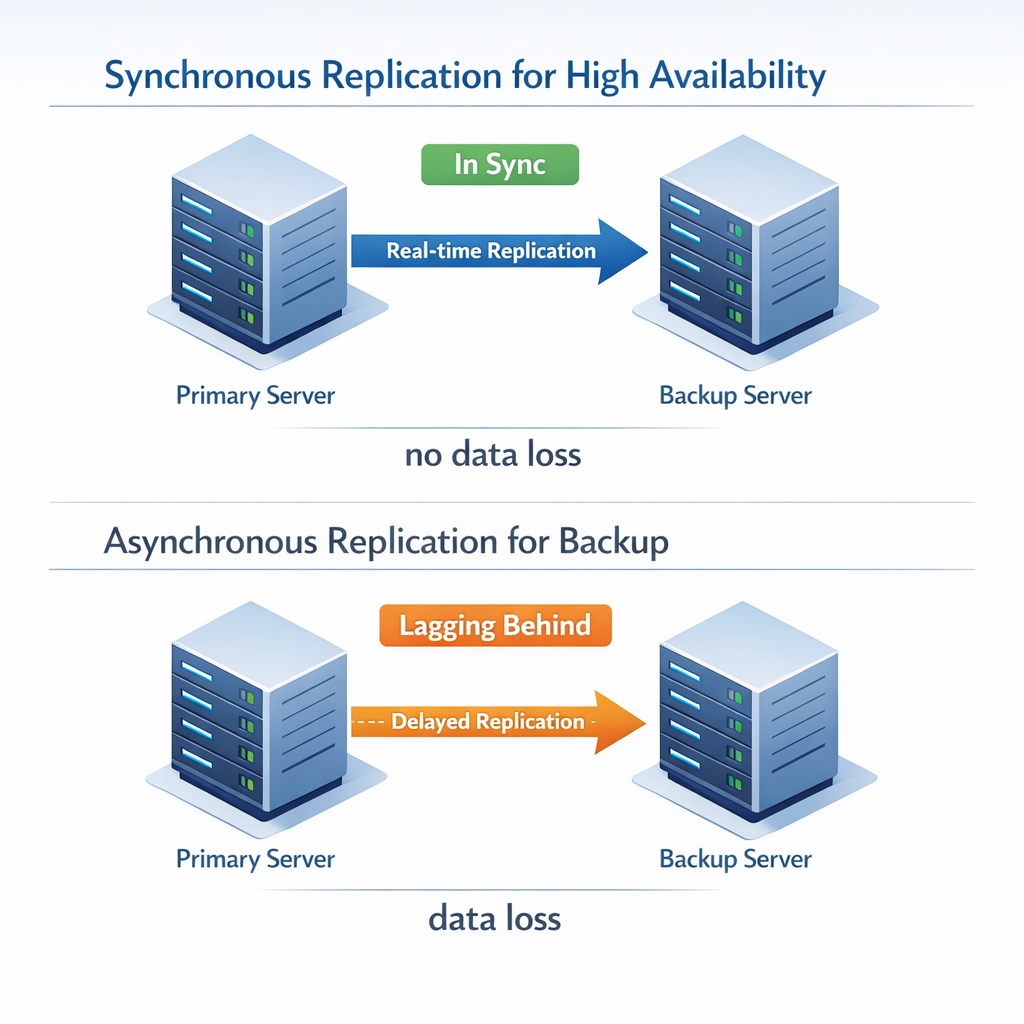
<li><strong>Synchronous replication</strong> , as implemented by <a href="/">SafeKit software</a>, is essential for <strong>High Availability (HA)</strong>. It ensures the failover of transactional applications without losing a single byte: all committed data on the primary server&rsquo;s disk is also present on the secondary server&rsquo;s disk.</li>
<li><strong>Asynchronous replication</strong> is typically used for <strong>Backup and Disaster Recovery (DR)</strong>. It carries a risk where committed data on the primary server&rsquo;s disk can be lost in the event of a failure because it was not yet copied to the remote site.</li>
<li><strong>Semi-synchronous replication</strong> is an alternative solution where committed data reaches the secondary server but is not necessarily written to its disk.</li>
</ul>
<p>It is important to understand that these solutions are <strong>complementary</strong>. While SafeKit’s synchronous replication protects your environment against hardware or software failures to maintain 24/7 uptime, a backup solution secures your historical data against logical errors and cyber threats like ransomware.</p>
<p>To help you make the right decision when choosing the best architecture for your needs, we explain the technical mechanisms and the impact on application failover below.</p>
<img src="/wp-content/uploads/2026/01/synchronous-asynchronous-replication-3-1024.jpg" width="512" alt="Comparison diagram of synchronous vs asynchronous replication showing data loss risk during failover">
<p><strong>Comparison of synchronous and asynchronous replication impact on data loss during application failover.</strong></p>
<div class="button-row">
  <a class="btn-action" href="https://safekit.eviden.com/contact-us-for-safekit/">🧑 Contact us</a>
  <a class="btn-action" href="/resources/safekit-free-trial/">🎁 SafeKit free trial</a>
  <a class="btn-action" href="https://training.my.evidian.com/mod/page/view.php?id=712">🏅 Free certification</a>
  <a class="btn-action" href="https://safekit.eviden.com/get-a-quote-safekit/">💰 Perpetual license cost</a>
</div>
<h2 id="table-of-contents">Table of Contents</h2>
<ul>
<li><a href="#data-loss-risk-synchronous-vs-asynchronous-failover">Data Loss or Not on Application Failover with Synchronous or Asynchronous Replication?</a></li>
<li><a href="#how-asynchronous-replication-works">How Asynchronous Replication Works?</a></li>
<li><a href="#how-synchronous-replication-works">How Synchronous Replication Works?</a></li>
<li><a href="#how-semi-synchronous-replication-works">How Semi-Synchronous Replication Works?</a></li>
<li><a href="#best-practices-synchronous-vs-asynchronous-replication">Final Verdict: Choosing the Right Replication for High Availability</a></li>
<li><a href="#comparison-synchronous-asynchronous-replication">Comparison Table: Synchronous vs. Asynchronous vs. Semi-Synchronous</a></li>
<li><a href="#videoguide-synchronous-real-time-replication-ha">Video Guide: Configuring Synchronous Real-Time Replication and High Availability</a></li>
<li><a href="#faq-replication-high-availability">FAQ: Replication Strategies in High Availability Clusters</a></li>
<li><a href="#hub">SafeKit High Availability Navigation Hub</a></li>
</ul>
<h2 id="how-asynchronous-replication-works">How Asynchronous Replication Works?</h2>
<p>In <strong>asynchronous replication</strong> , the primary server acknowledges write operations immediately, updating replicas later in <strong>scheduled batches</strong> with delay. This decoupling overcomes the latency issues of <strong>long-distance replication</strong> , making it a preferred strategy for <strong>backups and disaster recovery</strong> across remote sites.</p>
<p>However, this efficiency introduces the challenge of <strong>consistency</strong> , where the secondary server may hold outdated information. Because the secondary update occurs after the primary write is finalized, any failure of the primary server will result in the loss of <strong>in-flight data</strong>.</p>
<h2 id="how-synchronous-replication-works">How Synchronous Replication Works?</h2>
<p>With <strong>synchronous replication</strong> as implemented by SafeKit, when a disk I/O operation is performed by the application or the file system cache on the primary server, the system ensures data consistency through a double-acknowledgment process.</p>
<p>SafeKit waits for the <strong>I/O acknowledgment</strong> from both the local disk and the secondary server before sending the final acknowledgment back to the application or the file system cache. This synchronous mechanism is essential for the <strong>failover of transactional applications</strong> , ensuring that transactions are fully secured on both nodes before they are considered committed.</p>
<h2 id="how-semi-synchronous-replication-works">How Semi-Synchronous Replication Works?</h2>
<p><strong>Semi-synchronous replication</strong> serves as a hybrid approach to data integrity. Like synchronous replication, SafeKit waits for an acknowledgment from both the primary and secondary servers before confirming the I/O operation to the application or file system cache.</p>
<p>The critical difference lies in the <strong>secondary server&rsquo;s response timing</strong>. In the semi-synchronous case, the secondary server sends an acknowledgment to the primary immediately upon <strong>receiving the data in memory</strong> , committing it to disk afterward. In contrast, <strong>synchronous replication</strong> requires the secondary server to write the I/O to the physical disk before sending the acknowledgment.</p>
<h2 id="best-practices-synchronous-vs-asynchronous-replication">Final Verdict: Choosing the Right Replication for High Availability</h2>
<p>The choice between <strong>synchronous vs. asynchronous replication</strong> is a trade-off between absolute data integrity and network performance. For mission-critical infrastructures, this decision directly determines your <strong>Recovery Point Objective (RPO)</strong>.</p>
<p><strong>In summary:</strong></p>
<ul>
<li><strong>Asynchronous Replication</strong> : The gold standard for <strong>backup</strong> but not for <strong>high availability</strong>. While it supports long-distance connectivity, there is an inherent risk of data loss <strong>because the secondary node data lags behind the primary node data.</strong></li>
<li><strong>Synchronous Replication:</strong> The gold standard for <strong>high availability</strong> but not for <strong>backup</strong>. It ensures the secondary node files are a real-time clone of the primary, guaranteeing <strong>zero-data-loss failover</strong>.</li>
<li><strong>Semi-Synchronous Replication:</strong> Provides a high-performance middle ground for <strong>high availability</strong>. By confirming data at the memory level before the disk write, it minimizes latency while maintaining superior data protection compared to asynchronous methods.</li>
</ul>
<p><strong>⭐ SafeKit Recommendation:</strong> For critical applications, always prioritize <strong>synchronous or semi-synchronous replication</strong> to guarantee business continuity, maximize performance, and eliminate the risks associated with inconsistent failover.</p>
<h2 id="comparison-synchronous-asynchronous-replication">Comparison Table: Synchronous vs. Asynchronous vs. Semi-Synchronous</h2>
<table>
<thead>
<tr>
<th>Feature</th>
<th>Synchronous</th>
<th>Semi-Synchronous</th>
<th>Asynchronous</th>
</tr>
</thead>
<tbody>
<tr>
<td>RPO (Potential Data Loss)</td>
<td>Zero</td>
<td>Zero</td>
<td>Not Zero (Data loss: depends on last asynchronous copy)</td>
</tr>
<tr>
<td>Remote I/O Acknowledgment</td>
<td>After remote disk write</td>
<td>After remote RAM write</td>
<td>Does not wait acknowledgment</td>
</tr>
<tr>
<td>Performance Impact</td>
<td>Requires a low latency network - Depends on Round Trip Time (typically RTT&lt;2ms)</td>
<td>Supports low latency network</td>
</tr>
<tr>
<td>Distance Limits</td>
<td>Local / Stretched VLAN</td>
<td>Wide Area Network (WAN)</td>
</tr>
<tr>
<td>Best For</td>
<td>High Availability (Automatic failover)</td>
<td>Backup Solutions (Manual Failover)</td>
</tr>
</tbody>
</table>
<h2 id="videoguide-synchronous-real-time-replication-ha">Video Guide: Configuring Synchronous Real-Time Replication and High Availability</h2>
<h3 id="demo-mirror-ha-cluster">SafeKit Video: Application-Level Clustering (8:47)</h3>
<p>In this video, discover how SafeKit implements a <strong>mirror HA cluster</strong> without the complexity of a SAN. While this demonstration uses Microsoft SQL Server, the solution works identically for other databases and applications.</p>
<h3 id="chapters">Chapters</h3>
<ol>
<li><a href="https://www.youtube.com/watch?v=mGwEguDnnH0&amp;amp;t=0s" target="_blank" rel="noopener">2 nodes with SQL Server</a> (0:32)</li>
<li><a href="https://www.youtube.com/watch?v=mGwEguDnnH0&amp;amp;t=32s" target="_blank" rel="noopener">Configure the cluster and the mirror.safe module</a> (3:58)</li>
<li><a href="https://www.youtube.com/watch?v=mGwEguDnnH0&amp;amp;t=270s" target="_blank" rel="noopener">Start and test SQL replication, migration, failover on crash</a> (4:17)</li>
</ol>
<h3 id="step-by-step-implementation">Step-by-Step Implementation</h3>
<ul>
<li><a href="/quick-install/safekit-quick-installation-guide-for-a-new-windows-application-with-real-time-replication-and-failover/">Read the guide on setting up a mirrored cluster on Windows</a></li>
<li><a href="/quick-install/safekit-quick-installation-guide-for-a-new-linux-application-with-real-time-replication-and-failover/">Read the guide on setting up a mirrored cluster on Linux</a></li>
</ul>
<p>&amp;amp;amp;amp;amp;amp;lt;br /&amp;amp;amp;amp;amp;amp;gt;</p>
<h2 id="faq-replication-high-availability">FAQ: Replication Strategies in High Availability Clusters</h2>
<h3 id="replication-technology--mechanics">Replication Technology &amp; Mechanics</h3>
<h4 id="safekit-byte-level-replication-vs-full-file-transfer">Does SafeKit send the full file over the network every time it is modified?</h4>
<p><strong>No.</strong> SafeKit utilizes <strong>byte-level replication</strong>. It intercepts specific I/O modifications inside files and replicates only the changed bytes, minimizing network traffic.</p>
<h4 id="safekit-synchronous-replication-timing">Is the replication triggered every time the application writes to its files?</h4>
<p><strong>No.</strong> Replication occurs only when the application requests an <strong>I/O commit</strong> to the local disk. SafeKit ensures this data is acknowledged by the secondary server before completing the write.</p>
<h4 id="synchronous-replication-performance-impact">Does synchronous replication slow down my application?</h4>
<p>Latency is tied to the <strong>Network Round Trip Time (RTT)</strong>. On a LAN, the impact is negligible (similar to NAS/SAN storage). On high-latency WANs, asynchronous modes are often preferred to avoid performance bottlenecks and a backup solution (not SafeKit) is required.</p>
<hr>
<h3 id="deployment-strategy-ha-vs-backup">Deployment Strategy: HA vs. Backup</h3>
<h4 id="choosing-sync-vs-async">When must I choose synchronous vs. asynchronous replication?</h4>
<p>Choose <strong>Synchronous</strong> for High Availability (automatic failover, zero data loss). Choose <strong>Asynchronous</strong> for Backup/DR where distance prevents real-time syncing and automatic failover is not required.</p>
<h4 id="safekit-support-asynchronous">Does SafeKit support asynchronous replication?</h4>
<p><strong>No.</strong> SafeKit is an HA solution requiring zero data loss for <strong>automatic failover</strong>. For purely asynchronous needs, look for Backup solutions.</p>
<h4 id="high-availability-vs-backup">Does High Availability remove the need for a backup solution?</h4>
<p><strong>No, high availability does not remove the need for a comprehensive backup solution.</strong></p>
<p>While real-time replication solutions like <a href="/">SafeKit</a> provide continuous business continuity, they serve a different purpose than backups. Real-time replication is designed to protect against hardware failure and server downtime, but it cannot protect against cyber threats like ransomware encrypting both nodes simultaneously. Only a backup solution with a retention policy can solve this issue.</p>
<h4 id="combining-synchronous-asynchronous-replication">How can I combine synchronous and asynchronous replication?</h4>
<p>You can use a <strong>3-node hybrid architecture</strong> : a 2-node local cluster with synchronous replication for HA, and a third remote copy via a backup solution with asynchronous replication for Disaster Recovery.</p>
<p><strong>See for more information:</strong> <a href="/best-practises/high-availability-disaster-recovery-hadr/">SafeKit High Availability and Disaster Recovery (HADR)</a></p>
<h2 id="hub">🔍 SafeKit High Availability Navigation Hub</h2>
<p><strong>Explore SafeKit: Features, technical videos, documentation, and free trial</strong></p>
<table>
<thead>
<tr>
<th>Resource Type</th>
<th>Description</th>
<th>Direct Link</th>
</tr>
</thead>
<tbody>
<tr>
<td><strong>Key Features</strong></td>
<td>Why Choose SafeKit for Simple and Cost-Effective High Availability?</td>
<td><a href="/#why-choose-safekit-for-ha" title="Discover SafeKit features for simple and cost-effective high availability">See Why Choose SafeKit for High Availability</a></td>
</tr>
<tr>
<td><strong>Use Cases</strong></td>
<td>Explore How SafeKit Ensures the High Availability of Critical Infrastructure</td>
<td><a href="/#safekit-use-cases" title="Explore SafeKit high availability use cases">See All Use Cases (OEM Software, Edge Servers, SCADA, and more)</a></td>
</tr>
<tr>
<td><strong>Deployment Model</strong></td>
<td>All-in-One SANless HA: Shared-Nothing Software Clustering</td>
<td><a href="/#all-in-one-sanless-ha" title="Learn about all-in-one SANless high availability with shared-nothing software clustering">See SafeKit All-in-One SANless HA</a></td>
</tr>
<tr>
<td><strong>HA Strategies</strong></td>
<td>SafeKit: Infrastructure (VM) vs. Application-Level High Availability</td>
<td><a href="/#safekit-ha-redundancy-choices" title="Compare VM-level redundancy with SafeKit application-level high availability strategies">See SafeKit HA &amp; Redundancy: VM vs. Application Level</a></td>
</tr>
<tr>
<td><strong>Technical Specifications</strong></td>
<td>Technical Limitations for SafeKit Clustering</td>
<td><a href="/#safekit-ha-limitations" title="Technical requirements and limitations for SafeKit application clustering">See SafeKit High Availability Limitations</a></td>
</tr>
<tr>
<td><strong>Proof of Concept</strong></td>
<td>SafeKit: High Availability Configuration &amp; Failover Demos</td>
<td><a href="/#safekit-failover-tutorials" title="Step-by-step videos on SafeKit high availability, from installation to automated failover">See SafeKit Failover Tutorials</a></td>
</tr>
<tr>
<td><strong>Architecture</strong></td>
<td>How the SafeKit Mirror Cluster works (Real-Time Replication &amp; Failover)</td>
<td><a href="/#safekit-mirror-cluster" title="See technical architecture and failover mechanism of SafeKit Mirror Cluster">See SafeKit Mirror Cluster: Real-Time Replication &amp; Failover</a></td>
</tr>
<tr>
<td><strong>Architecture</strong></td>
<td>How the SafeKit Farm Cluster works (Network Load Balancing &amp; Failover)</td>
<td><a href="/#safekit-farm-cluster" title="Technical overview of SafeKit Farm Cluster architecture with network load balancing">See SafeKit Farm Cluster: Network Load Balancing &amp; Failover</a></td>
</tr>
<tr>
<td><strong>Competitive Advantages</strong></td>
<td>Comparison: SafeKit vs. Traditional High Availability (HA) Clusters</td>
<td><a href="/#safekit-ha-comparison" title="Detailed comparison of SafeKit software vs traditional hardware-based HA clusters">See SafeKit vs. Traditional HA Cluster Comparison</a></td>
</tr>
<tr>
<td><strong>Technical Resources</strong></td>
<td>SafeKit High Availability: Documentation, Downloads &amp; Trial</td>
<td><a href="/#safekit-ha-technical-resources" title="Access SafeKit free trial, technical documentation, and high availability white papers">See SafeKit HA Free Trial &amp; Technical Documentation</a></td>
</tr>
<tr>
<td><strong>Pre-configured Solutions</strong></td>
<td>SafeKit Application Module Library: Ready-to-Use HA Solutions</td>
<td><a href="/#safekit-ha-application-modules" title="Browse the library of pre-configured SafeKit modules for automated application failover">See SafeKit High Availability Application Modules</a></td>
</tr>
</tbody>
</table>
<div class="button-row">
  <a class="btn-action" href="https://safekit.eviden.com/contact-us-for-safekit/">🧑 Contact us</a>
  <a class="btn-action" href="/resources/safekit-free-trial/">🎁 SafeKit free trial</a>
  <a class="btn-action" href="https://training.my.evidian.com/mod/page/view.php?id=712">🏅 Free certification</a>
  <a class="btn-action" href="https://safekit.eviden.com/get-a-quote-safekit/">💰 Perpetual license cost</a>
</div>