---
title: "SAN vs. NAS Shared Storage for Failover Clustering: A Detailed Comparison"
description: "SAN vs. NAS Shared Storage for Failover Clustering: A Detailed Comparison What is the simplest solution between a SAN vs a NAS shared storage for a failover cluster?"
canonical: "https://safekit.eviden.com/best-practises/san-vs-nas-shared-storage-for-a-failover-cluster/"
topics: "What is the simplest solution between a SAN vs a NAS shared storage for a failover cluster?, 🔍 SafeKit High Availability Navigation Hub"
category: "best-practises"
lang: "en"
---

<h1 id="san-vs-nas-shared-storage-for-failover-clustering-a-detailed-comparison">SAN vs. NAS Shared Storage for Failover Clustering: A Detailed Comparison</h1>
<h2 id="what-is-the-simplest-solution-between-a-san-vs-a-nas-shared-storage-for-a-failover-cluster">What is the simplest solution between a SAN vs a NAS shared storage for a failover cluster?</h2>
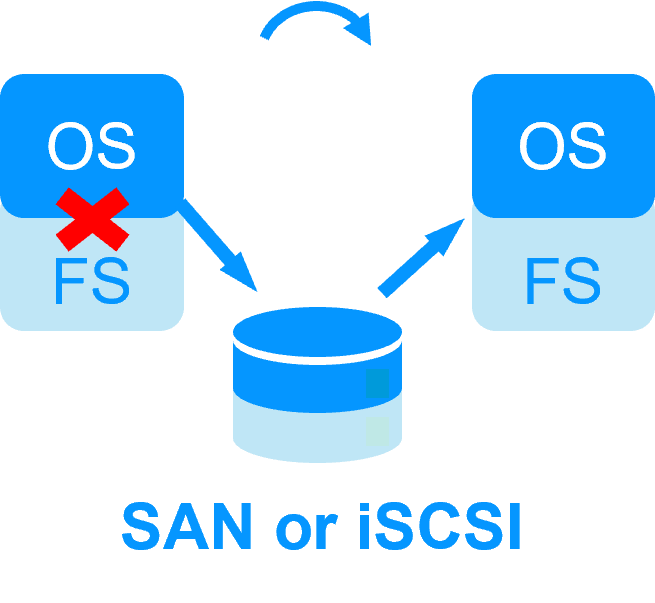
<h3 id="san-shared-storage-or-nas-iscsi-shared-storage-for-a-failover-cluster">SAN shared storage or NAS iSCSI shared storage for a failover cluster</h3>
<img src="/wp-content/uploads/2023/03/raw-disk-shared-storage.png" width="200" alt="SAN shared storage or NAS iSCSI shared storage for a failover cluster">
<p>There are several elements that make this architecture complex to implement:</p>
<ul>
<li>on failover, switching the shared storage requires low level instructions which are storage manufacturer dependent,</li>
<li>recovery procedure on the file system (FS) must be passed before restarting the application,</li>
<li>if both file systems on both nodes access the same raw disk at the same time, the full file system will be corrupted,</li>
<li>to avoid a double access, a quorum disk must be configured.</li>
</ul>
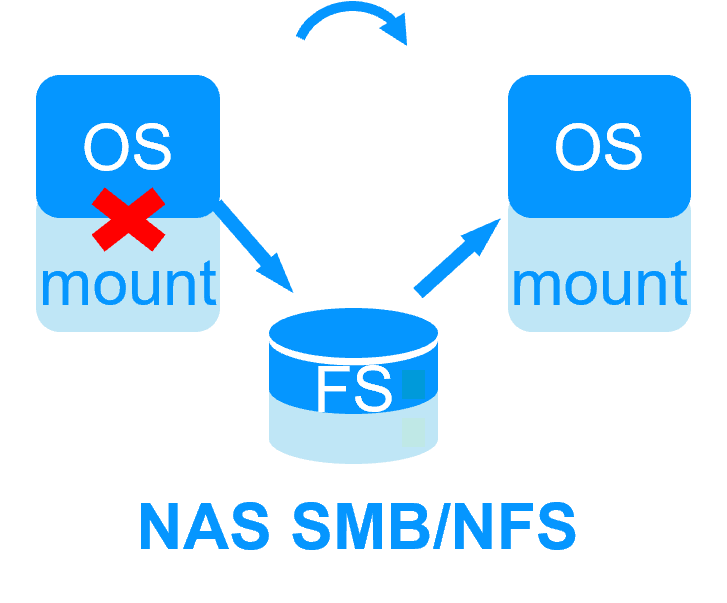
<h3 id="nas-smb-shared-storage-or-nas-nfs-shared-storage-for-a-failover-cluster">NAS SMB shared storage or NAS NFS shared storage for a failover cluster</h3>
<img src="/wp-content/uploads/2023/03/nas-shared-storage-1.png" width="200" alt="NAS SMB shared storage or NAS NFS shared storage for a failover cluster">
<p>There are several elements that make this architecture simple to implement:</p>
<ul>
<li>on failover, switching the shared storage means only remounting the external file system,</li>
<li>no recovery procedure on the file system must be passed before restarting the application,</li>
<li>if both nodes access the same shared file system at the same time, the full file system will be not be corrupted,</li>
<li>however, there is still the possibility of a double execution of the same application corrupting its data in the shared storage when nodes are isolated.</li>
</ul>
<h3 id="real-time-replication-and-failover-with-eviden-safekit">Real-time replication and failover with Eviden SafeKit</h3>
<img src="/wp-content/uploads/2023/03/no-shared-storage.png" width="200" alt="Real-time replication and failover with SafeKit">
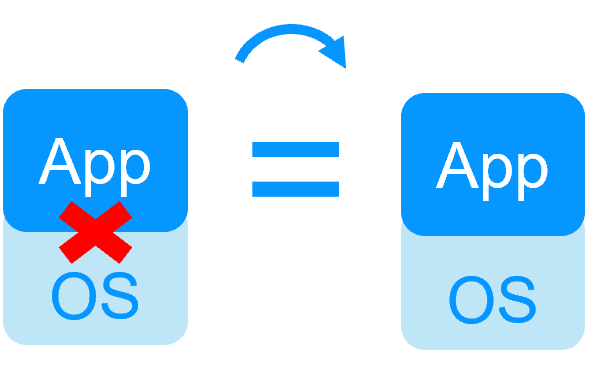
<p>There are no such issues with SafeKit because its replication and failover solution does not require a shared storage.</p>
<p>However, if SafeKit must manage a shared storage:</p>
<ul>
<li>use a NAS SMB shared storage or a NAS NFS shared storage,</li>
<li>put in the restart scripts the mount/umount of the external file system,</li>
<li>configure the <a href="/best-practises/heartbeat-failover-quorum-windows-linux-cluster/">SafeKit split brain checker</a> to avoid a double execution of the same application accessing the shared storage when nodes are isolated.</li>
</ul>
<h2 id="hub">🔍 SafeKit High Availability Navigation Hub</h2>
<p><strong>Explore SafeKit: Features, technical videos, documentation, and free trial</strong></p>
<table>
<thead>
<tr>
<th>Resource Type</th>
<th>Description</th>
<th>Direct Link</th>
</tr>
</thead>
<tbody>
<tr>
<td><strong>Key Features</strong></td>
<td>Why Choose SafeKit for Simple and Cost-Effective High Availability?</td>
<td><a href="/#why-choose-safekit-for-ha" title="Discover SafeKit features for simple and cost-effective high availability">See Why Choose SafeKit for High Availability</a></td>
</tr>
<tr>
<td><strong>Use Cases</strong></td>
<td>Explore How SafeKit Ensures the High Availability of Critical Infrastructure</td>
<td><a href="/#safekit-use-cases" title="Explore SafeKit high availability use cases">See All Use Cases (OEM Software, Edge Servers, SCADA, and more)</a></td>
</tr>
<tr>
<td><strong>Deployment Model</strong></td>
<td>All-in-One SANless HA: Shared-Nothing Software Clustering</td>
<td><a href="/#all-in-one-sanless-ha" title="Learn about all-in-one SANless high availability with shared-nothing software clustering">See SafeKit All-in-One SANless HA</a></td>
</tr>
<tr>
<td><strong>HA Strategies</strong></td>
<td>SafeKit: Infrastructure (VM) vs. Application-Level High Availability</td>
<td><a href="/#safekit-ha-redundancy-choices" title="Compare VM-level redundancy with SafeKit application-level high availability strategies">See SafeKit HA &amp; Redundancy: VM vs. Application Level</a></td>
</tr>
<tr>
<td><strong>Technical Specifications</strong></td>
<td>Technical Limitations for SafeKit Clustering</td>
<td><a href="/#safekit-ha-limitations" title="Technical requirements and limitations for SafeKit application clustering">See SafeKit High Availability Limitations</a></td>
</tr>
<tr>
<td><strong>Proof of Concept</strong></td>
<td>SafeKit: High Availability Configuration &amp; Failover Demos</td>
<td><a href="/#safekit-failover-tutorials" title="Step-by-step videos on SafeKit high availability, from installation to automated failover">See SafeKit Failover Tutorials</a></td>
</tr>
<tr>
<td><strong>Architecture</strong></td>
<td>How the SafeKit Mirror Cluster works (Real-Time Replication &amp; Failover)</td>
<td><a href="/#safekit-mirror-cluster" title="See technical architecture and failover mechanism of SafeKit Mirror Cluster">See SafeKit Mirror Cluster: Real-Time Replication &amp; Failover</a></td>
</tr>
<tr>
<td><strong>Architecture</strong></td>
<td>How the SafeKit Farm Cluster works (Network Load Balancing &amp; Failover)</td>
<td><a href="/#safekit-farm-cluster" title="Technical overview of SafeKit Farm Cluster architecture with network load balancing">See SafeKit Farm Cluster: Network Load Balancing &amp; Failover</a></td>
</tr>
<tr>
<td><strong>Competitive Advantages</strong></td>
<td>Comparison: SafeKit vs. Traditional High Availability (HA) Clusters</td>
<td><a href="/#safekit-ha-comparison" title="Detailed comparison of SafeKit software vs traditional hardware-based HA clusters">See SafeKit vs. Traditional HA Cluster Comparison</a></td>
</tr>
<tr>
<td><strong>Technical Resources</strong></td>
<td>SafeKit High Availability: Documentation, Downloads &amp; Trial</td>
<td><a href="/#safekit-ha-technical-resources" title="Access SafeKit free trial, technical documentation, and high availability white papers">See SafeKit HA Free Trial &amp; Technical Documentation</a></td>
</tr>
<tr>
<td><strong>Pre-configured Solutions</strong></td>
<td>SafeKit Application Module Library: Ready-to-Use HA Solutions</td>
<td><a href="/#safekit-ha-application-modules" title="Browse the library of pre-configured SafeKit modules for automated application failover">See SafeKit High Availability Application Modules</a></td>
</tr>
</tbody>
</table>
<div class="button-row">
  <a class="btn-action" href="https://safekit.eviden.com/contact-us-for-safekit/">🧑 Contact us</a>
  <a class="btn-action" href="/resources/safekit-free-trial/">🎁 SafeKit free trial</a>
  <a class="btn-action" href="https://training.my.evidian.com/mod/page/view.php?id=712">🏅 Free certification</a>
  <a class="btn-action" href="https://safekit.eviden.com/get-a-quote-safekit/">💰 Perpetual license cost</a>
</div>